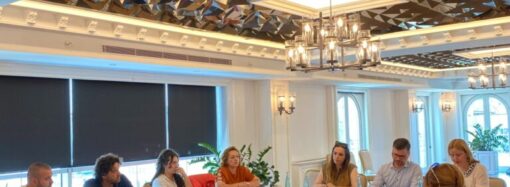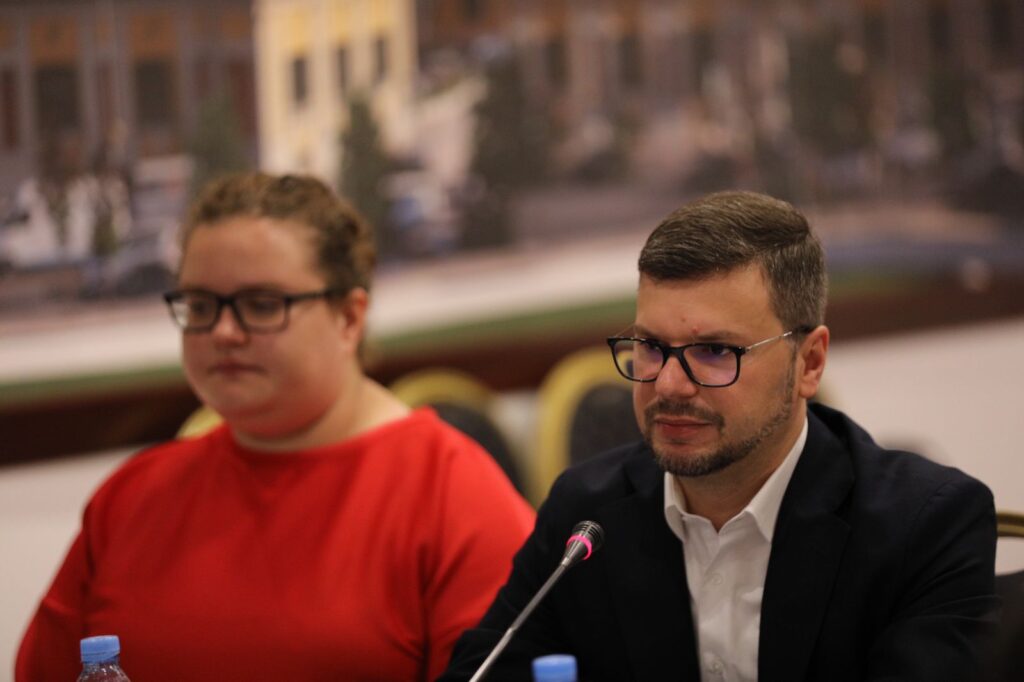
On June 17 2022, a discussion table was held on the business environment, the update of Albanian legislation and harmonisation with the EU Acquis (Chapter 20). This activity was organized in the framework of the National Convention for European Integration 2021-2023. by EMA and the National Council of European Integration (KKEI) in cooperation with the Slovak Foreign Policy Association, with the financial support of SlovakAid. In the activity representatives from state institutions, diplomatic missions, the sector of civil society, the business community and universities took part and were actively involved. The activity took place in the hybrid format, with physical participation at Tirana International Hotel and online on the ZOOM platform.
The meeting was opened by Gledis Gjipali, Executive Director of European Movement Albania (EMA), he said that the process of European Integration is focused on the political issues, for this reason, through the Convention, in a more technical aspect the attention is given to the social and economic issues. The Convention is integrating various components in order to continue the dialogue and to shed light on important issues, such as the topic that will be treated in today’s meeting with focus on business and the measures that must be taken, in order to make an environment as suitable as possible for business’s development.
Jorida Tabaku, Chairwoman of the National Council of the European Integration (KKEI), during her presentation underlined the process of development of industrial policies included in Chapter 20. She said that the exchange between the Technical Secretariat of the KKIEl and civil society is very valuable and highlighted that civil society plays an extraordinary role in the strengthening of this process. Regarding the approximation of Albanian legislation with EU legislation, according to her, the problem remains not only in its implementation, but also how this legislation affects the daily life of business operators. Tabaku broughtinto attention the case of the law of viticulture and stated that the producers consider the time to implement this law to be 4 years. Further, during her presentation, she brought up the example of Serbia and said that it isn’t good at all that Albania has not a favourable ranking in doing business and according to her, this is all a matter of national policies adopted and implemented. Among other things, she expressed the concern that we still do not have an example of the impact, to see how the implications of the implementation of such law are in practice. The meeting was continued in a discussion form with the participants, where Tabaku spoke about the impacts that the approximation of this law will have on the small businesses, as one of the interest groups that must be informed and included in topics and issues related with the Chapter 20.
The word was taken by Elda Zenelaj, Director of the Technical Secretariat at KKIE, who said that in the last two years, the Secretariat in cooperation with the civil society organisations, have organised 6 activities focused on various topics such as food security or Green Agenda etc. Zenelaj highlighted that the ex-post judgement has been introduced and soon our country will see the results of this approximation, and important is not only the issue of impact, but also the monitoring that should be done related with the other part.
The word was taken by Adriána Valášková, Director of the Business Environment Development Sector at the Ministry of Economy in Slovakia. She started her presentation by explaining the barriers of business in Albania such as: informality, administrative burden, bankruptcy, administrative and legal difficulties etc. Among other things, Valášková did not hesitate to bring the best practices from Slovakia, with a focus on the drafting and consultation process at this chapter. She talked about the Government Council of the Slovak Republic for Competitiveness and Productivity, where she highlighted that its fundamental task is to monitor, analyse and evaluate the productivity and the competitiveness of the business, especially related with issues such as business environment, innovation etc. Further, during her speech, she spoke about the role of business actors in the consultations and in providing recommendations. Valášková highlighted that for each consultation round, participants are invited to participate in those topics that are directly affected by the drafted legal material, and the role of these subjects is to agree or to disagree with the material, to determine which parts they do not agree with and to suggest possible solutions. The participants had a special interest for the case of Slovakia, the evaluation of the Integration Process, as well as the evaluation of the quality, whether the parliament is involved in this process or not, and also to know more about the measures that they take and the commenting process.
Furthermore, Gjipali added that everything is well evaluated based on experiences and here civil society also has a very important role. The case of Slovakia is very interesting and has much importance, not only in the approximation of the legislation, but also in the way of its implementation. Gjipali also highlighted the importance of organising such tables, because the institutions are indeed moving towards formal alignment, but it is very important to see how these alignments are affected and shaped in reality.