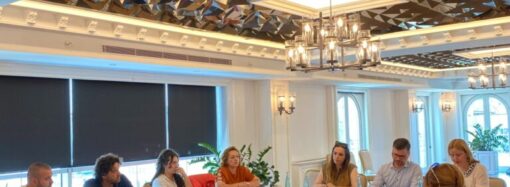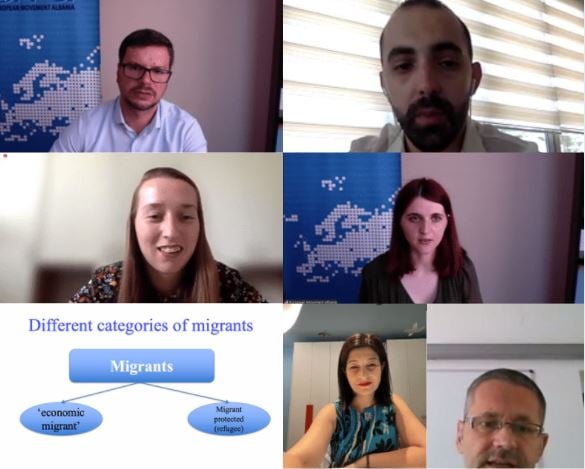
On July 21, 2021 European Movement in Albania (EMA) and National Chamber of Advocates, in partnership with the Slovak Foreign Policy Association and the financial support of Slovak Aid, organized Session 2 under the Working Group II (Justice, Freedom, Security) of the National Convention on European Integration 2019-2021. The topic was “Dealing with refugee’s issues – quota program in EU and Slovakia – lessons learned for Albania”.
Nirvana Deliu, Policy Researcher of European Movement Albania, thanked the participants and briefly explained the objectives of the National Convention for European Integration. Deliu pointed out that a relevant part of the NCEI are the Working Groups created to deliberate on the Acquis Chapters and gain experience from experts in other countries. Moreover, she analyzed a study that EMA has conducted related to the Migrant Integration Policies in Albania, mentioning that in some fields national policies are favorable such as family reunion and access to nationality, but in other fields the integration process of foreigners is lacking like in education, health and political participation.
Dr. Enkelejda Koka, from European University of Tirana held a presentation about irregular migration and said that for a long period of time migrants have been using unsafe sea ways like overcrowded vessels to move. She stated that since 2011, boats have been arriving with migrants with different needs in international waters asking to be rescued. Nearby governmental or private vessels have a legal obligation to respond to the call for rescue. The migrants need to be disembarked to a safe zone. The Covid-19 situation was used by Malta, Libya and Italy to declare their ports unsafe preventing boats that rescue irregular migrants with a foreign flag to be disembarked. These actions violate: the right to asylum, right to life, right to rescue, and of principle of non-refoulement. On April 10, 2020 more than 150 people were stranded at sea waiting to be disembarked in a safe port. They were rescued by the NGO vessel Sea Eye. Irregular migrants were forced to jump into water after being hindered by Libyan militia firing shots toward their vessel. Nowadays, NGOs have to take permission form the government of Malta or Italy and they are only accepting if other countries do arrangements to transfer them. These actions violate the main principles: 1) Right to adequate medical care (equal access to healthcare and the 2) right to be rescued.
Alzbeta Kvasnickova from the Migration Office of the Slovak Republic said that the Slovak asylum system is based on the Convention related to the status of refugees of 1951 (the Geneva Convention) and the protocol relating to the status of refugees of 1967 (the New York Protocol). The Slovak Republic has adopted the definition of refugee in line with the Geneva Convention article 1a. Kvasnickova clarified that within the asylum procedure Slovakia proceeds in accordance with the international and European instruments on protection of human rights and with two main Treaties of EU: TEU and TFEU. Regarding to the Slovak legislation the most essential document relevant in the field of asylum is the Constitution of the Slovak Republic. In Slovakia the only responsible state body for the asylum procedure is the migration office. She then explained what the terms like asylum, subsidiary protection, asylum on humanitarian ground are in the context of Slovak and European law. She offered a detailed picture of institutional framework and of the legal procedure to be followed on granting asylum and on protection of human rights and main principles.