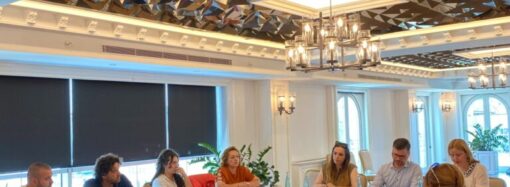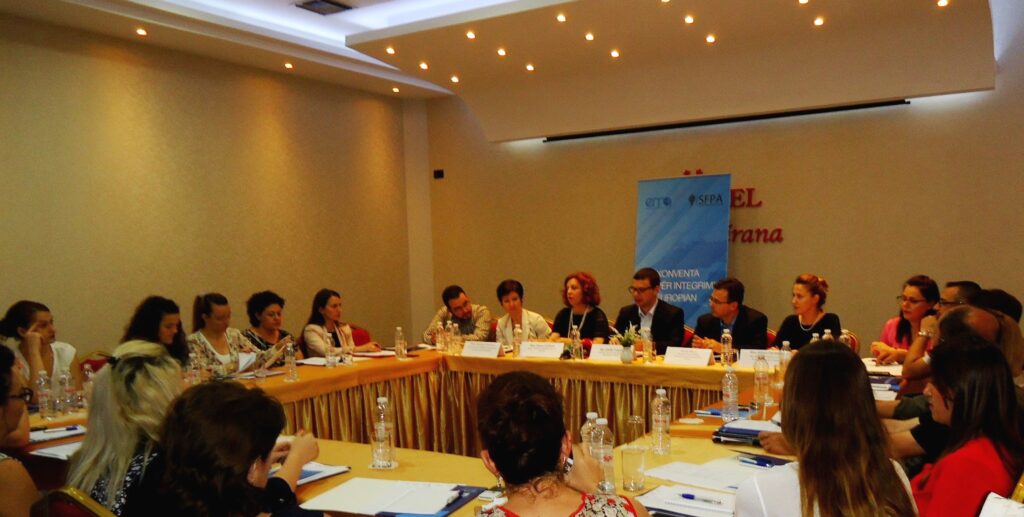
On 18 June 2015, European Movement in Albania (EMA) in partnership with Slovak Foreign Policy Association, with the support of the Ministry of European Integration and Ministry of Internal Affairs organized the Session 1 of Working Group II ” Migration and Asylum Policies”.
Mrs. Elona Gjebrea, Deputy Minister of Internal Affairs in Albania considered the activity as a very serious project and stressed the importance and the main role of the civil society in integration process as well as the awareness of society for the impact and benefits of this process. According to Mrs. Gjebrea, Working Groups with their recommendations guarantee success and help in improving the work of Ministry. That’s why these recommendations should be taken in consideration as well as the EU recommendations which are also mandatory. The Deputy Minister considered success so far within the Chapter 24, adoption of State Police Law, the Strategy on Integrated Border Management, the Strategy on Fight against Human Trafficking, the Online Application “Raporto dhe Shpeto”. Since within twenty days, The New Migration Profile will be presented, Mrs. Gjebrea asked for cooperation with the civil society. She also reemphasized that the asylum – seekers phenomena is still a concern for Albania and as said before there will be no possibility for the economic asylum – seekers to get the asylum right. She gave the message that the place of the Albanian is in Albania and that they should not be victims of frauds.
Mr. Ilirjan Xhezo, Director of Sector Policies in Ministry of European Integration, also stressed the importance of civil society as a very important partner. According to Mr. Xhezo, the participation of civil society is a pre – condition for a comprehensive process. He mentioned the need of a strong and active civil society to fulfil the mission of Albania in European Integration path.
The expert from Slovakia, in the same time Head of Office International Organization of Migration in Slovakia, Mrs. Zuzana Vatralova, talked about Slovak policy migration experience and lessons learned from her country. She explained that Slovakia, before entering the EU, didn’t have a regular legal framework in the field of migration policy. They became adopted after the membership of Slovakia in EU. Before membership, in Slovakia the number of asylum- seekers was about 12, 000 applications per year, while the number has decreased after the membership.
To Mrs. Vatralova, the migration policies in Slovakia today give the possibility to have a flexible and manageable process. According Mrs. Vatralova, The Civil Society Organization has played the main role in this process in Slovakia.
Mrs. Etleva Dyrmyshi, Expert of Migration, Ministry of Work, Social Welfare and Youth assessed as positive the opened activities with civil society especially for asylum policies, knowing that a lot of Albanians are directly affected by these problems. Mrs. Dyrmyshi concretized the policies of Ministry of Work, Social Welfare and Youth, for both irregular and regular migration. She also talked about the measures that are provided in the Strategy for re – integration in society of returned migrants. According Mrs. Dyrmyshi, all these measures will be undertaken
by implementing important principles as non – discrimination and equal treatment.
Mrs. Teuta Grazhdani, Project Manager and Developer, International Organization of Migration in Albania, analysed the management of asylum policies, especially those of migration in Albania. The lack of comprehensive approaches and the absence of a comprehensive document for these policies is a problem for Albania in this path. So for Mrs. Grazhdani, one solution would be the existence of a comprehensive document and another one would be concrete practices and policies for migration. Another problem stressed by Mrs. Concerning the Strategy on Reintegration of Returned Albanian Citizens, it is necessary that the consultation and information offices offer a package of more concise information, attached with practical and concrete advices for returned emigrants, including here the vulnerable groups and their specific needs. For Mrs. Grazhdani, the phenomena of Albanian asylum- seekers especially in Germany and migration of unaccompanied minors toward Europe, are also problems that need urgent solution.
The Panel was followed by discussions and recommendations between representatives from state institutions and civil society organizations such as IOM,UNHCR, ICMPD, RMSA, ARTI etc.