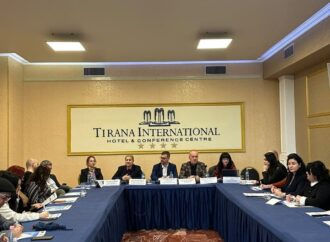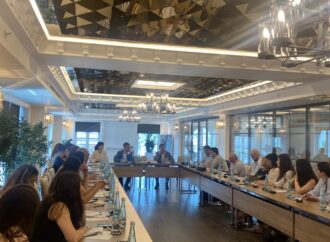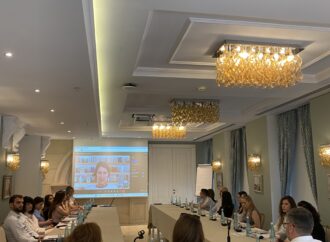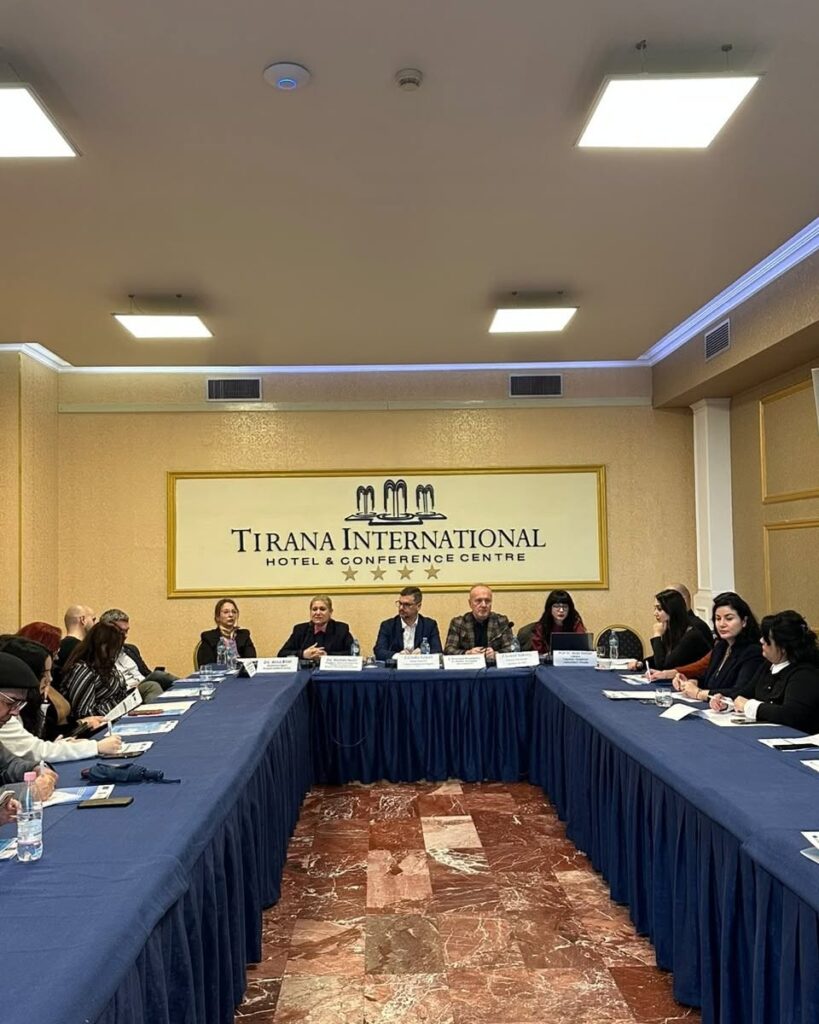
The roundtable on Chapter 28, “Consumer and Health Protection”, was dedicated to presenting and discussing the legal novelties of the Law No.116/2026 “On Consumer Protection”, as well as its implications for the responsible institutions and the actors involved in this field. The roundtable, held on 18 November 2026, was organised by the Ministry of Economy and Innovation, the European Movement in Albania (EMA) and the Alert Centre, within the framework of the Partnership Platform for European Integration and the National Convention for European Integration.
In his welcome address, Mr. Gledis Gjipali, Executive Director, European Movement in Albania (EMA), underlined the importance of discussion and consultation roundtables within the European integration process, as an opportunity to assess the progress achieved, identify challenges and discuss the developments that accompany the alignment of Albania legislation with the EU acquis. He underlined that, in the field of consumer protection, Albania has had an existing legal framework, but the adoption of the new legislation is an important development towards strengthening and updating it, in line with EU standards and requirements. In this context, he highlighted the importance of discussing the legal novelties and understanding the implications they bring for the responsible institutions and the actors involved in this field, so that the process of legislative alignment is accompanied by a continuous assessment of progress and of implementation challenges.
Next, Mr. Granit Sokolaj, Executive Director of the ALERT Centre, focused on the importance of the effective implementation of the new consumer protection legislation, stressing that strengthening the legal framework must be accompanied by concrete commitment from all actors working in this field. He noted the role of consumer protection organisations in informing and raising citizens’ awareness of their rights, identifying problems encountered in the market and contributing to the process related to the protection of these rights. In this regard, he stressed the need for consumer organisations to be actively involved in the implementation of the new framework, by helping to identify violations, address problems and strengthen cooperation with the responsible institutions, so that the new legal provisions are translated into concrete and effective protection for consumers.
Ms. Klotilda Neziri, Head of the Consumer Education and Protection Sector at the Ministry of Economy and Innovation, underlined that this year’s European Commission Report assesses Albania’s preparation for Chapter 28, Consumer and Health Protection, as being at a stage between early stage and limited preparation. She stated that the new consumer protection law, already published in the Official Gazette, is an important step towards the harmonisation of Albanian legislation with the EU acquis, as it transposes 14 EU directives and one regulation, including Directives adopted during the period 2019-2025. The law also provides for a six months period from its entry into force until the start of its application, which will serve to prepare the institutions, to build and strengthen administrative capacities, and to inform and raise the awareness of the actors involved. In this regard, it was pointed out that the process of legislative harmonisation has advanced significantly, while only four acts of the EU acquis remain that have been transposed into Albanian legislation. To fulfil the obligations under Chapter 28, she underlined the importance of coordination between the Ministry of Economy and Innovation, the other institutions responsible for implementing the legislation, and the structures that will have a role in the functioning of the new consumer protection agency. In conclusion, Ms. Neziri noted that the process of implementing the law and meeting European standards cannot rely solely on the activity of public institutions, but also requires the active engagement of consumer protection associations. She stressed that these organizations have an important role in informing and educating consumers and in identifying problems related to the implementation of the legislation.
Prof. Dr. Nada Dollani, Lecturer, Faculty of Law, University of Tirana, addressed the main novelties of Law No.116/2026 “ On Consumer Protection”, which consists of 245 articles, 6 parts and 3 annexes, and fully aligned Albania law with 14 EU directives. Among the main novelties of the law, she dwelt on increased price transparency, through the obligation to display both the selling price and the unit price, which must include VAT and all other taxes. She presented the example of a product with a selling price of 900 lek and a unit price of 1,200 lek, as well as the 30-day rule of announcing price reductions, according to which the prior price must be the lowest price applied during at least the 30 days before the reduction. In this context, it was stressed that for goods that spoil quickly, or that have been on market for less than 30 days, the lowest price applied during the relevant period is taken into account, while for progressive reductions the price without reduction covered the obligations to inform the consumer of the full price of the product, including additional taxes ad fees, before the contract is concluded, as well as the obligations that the order button clearly state “place order with payment obligation”. The law also provides for the obligation to obtain express consent for additional payments, as well as the consumer’s right to a refund when such payments were made without their consent. Another important novelty is the right of withdrawal from distance contracts within 15 calendar days, without giving any reason and no cost, with the trader obligated to refund payments within this period and the consumer, obliged to return the goods, if the consumer is not informed of this right, the withdrawal period may be extended by up to 12 months after the end of the initial 14-day period. Prof. Dr. Dollani also addressed the obligations of online platform regarding the transparency of research result rankings, the publications of the main ranking parameters and their relative importance, the identifications of paid advertisement, informing users whether the seller is a trader or not, and transparency on how the authenticity of consumer reviews is verified, with fake reviews considered a prohibited practice, In the ares of unfair commercial practices and misleading advertising, Dollani dwelt on the prohibition of generic or unsubstained environmental claims, sustainability labels without a certification scheme, claims of natural or positive environmental improvements without verifiable plans. She then turned to the right to repair, explaining that during the first year defect is presumed to have existed at the time of the delivery, unless proven otherwise. The consumer must notify the seller of the defect within two months of discovering it and may choose between repair and replacement of the goods, while choosing repair extends the seller’s liability period by 12 months. Repair must be carried out free of charge, within a reasonable time and without a significant inconvenience to the consumer, and during the process the seller may also offer a replacement good, including refurbished goods. In conclusion, she emphasized the importance of these changes for strengthening transparency in commercial relations, protecting consumers in the digital environment, preventing deceptive practices and promoting sustainable consumptions, bringing a more advanced framework of consumer rights and trader obligations in line with the EU standards.
Ms. Alma Bilali, Legal Adviser in the SENECA II/GIZ project, presented the role, structure and powers of the National Consumer Protection Agency (AKMK), the new institution expected to be established within one year to implement and supervise the new legal framework. She dwelt on the 26 powers the Agency will exercise, emphasizing the importance of cooperations between consumer protection authorities, the exchange of the harmonisation of minimum powers, particularly in cases where violations of consumer rights extended beyond the borders of one state. Among the new identity, for investigative purposes and the gathering of evidence, as well as the right to access trader’s documentation, promises, equipment or means of transport in order to verify possible violations. The Agency will also have the power to conduct investigations on its own initiative, on the basis of consumer complaints and, in cases of large-scale violations, to apply to the court event where the trade has continued the unlawful practice despite the measures taken. Another important power addressed by Mr. Bilali concerns the tracing of financial transfers between traders and consumers, as well as intervention in online commerce, by ordering the removal or restriction of unlawful content, including products and services that violate consumer rights, cooperating, where necessary, with other institutions or hosting services providers. Regarding the organisational structure, it was announced that AKMK will consist of four directorates, with specialised functions for the protection of consumer’s collective interests and the monitoring of digital markets, field investigations ans access to trade’s premises, and alternative dispute resolutions, the letter to be integrated into the Agency form the existing directorate set up at the Ministry of Economy and Innovation. The Agency will also be supported by the legal services, which will provide assistance for investigations and represent the Agency in court; by statistical functions for collecting and analysing data in support of the policy-making; and by the administration of projects and funds dedicated to consumer protection, including cooperation with consumer protections organisations.
During the discussions, participants dwelt on the need to secure human resources and strengthen their capacities for the effective functioning of AKMK, and the transitional phases foreseen for the implementation of the law, its interaction with the other sectoral laws, and the division of powers between the responsible institutions. It was clarified that AKMK will not have the status of an inspectorate, while its structure will provide for collegial decision-making mechanisms and the establishment of a Permanent Advisory Commission, in which consumer protection organisations will be able to be represented. In this context, the importance was stressed of taking into account the positions and the recommendations of all stakeholders through the further implementation of the law.
*The Discussion and Consultation Roundtables on Chapter 28 are organised pursuant to Prime Minister’s Order No. 113, dated 30.08.2019, “On the forms of participation, functioning and institutional structure of the Partnership Platform for European Integration“.
*This roundtable took place within the project “Green line for consumer protection – Food safety and strengthening the protection of consumer rights in Albania through the empowerment of local CSOs”, financed by the European Union (IPA III/2024), which is being implemented by the Alert Center in cooperation with the European Movement in Albania (EMA).